Robtel Neajai Pailey’s “Development, (Dual) Citizenship and Its Discontents in Africa” (Black Agenda Report)

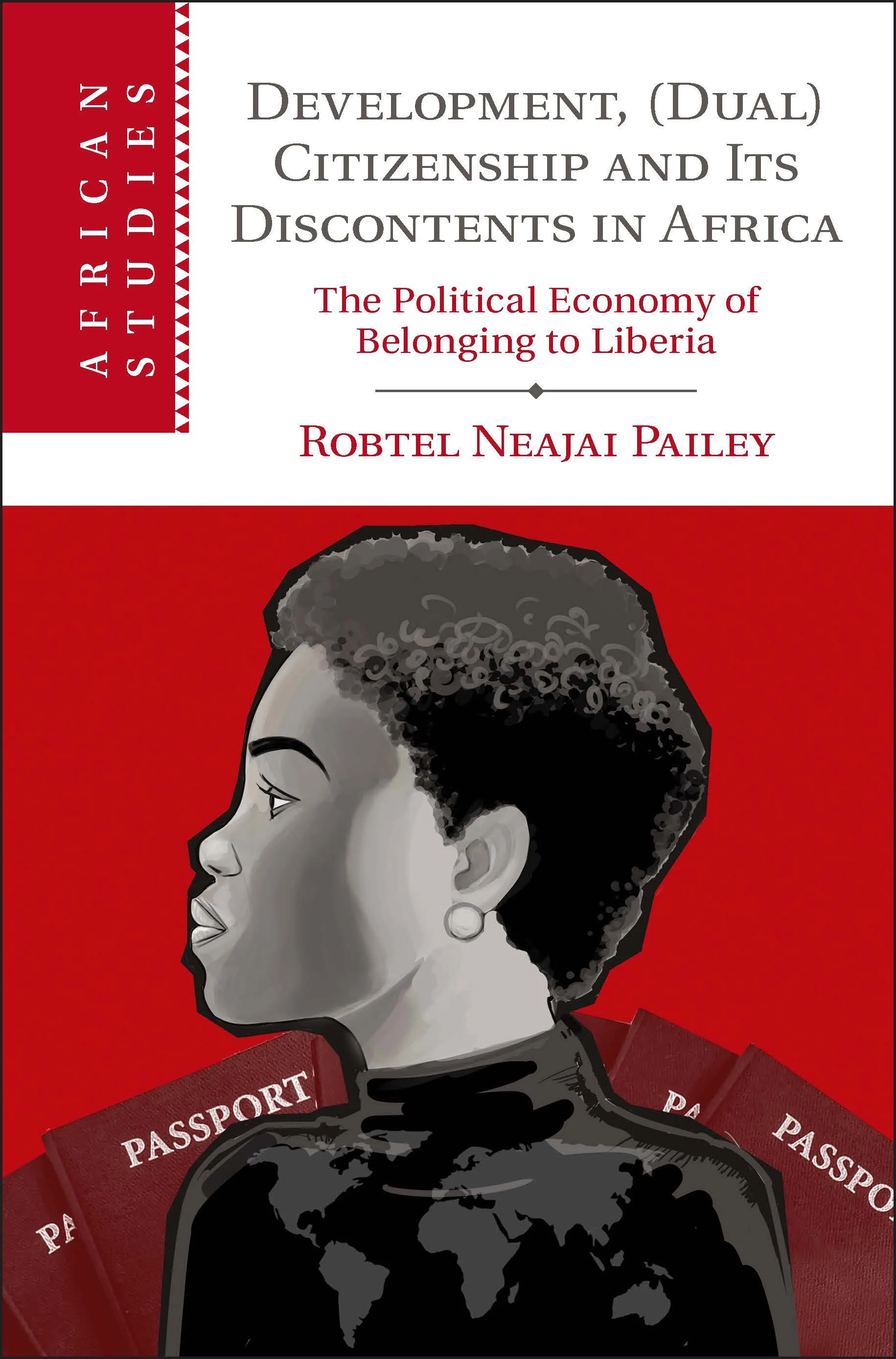
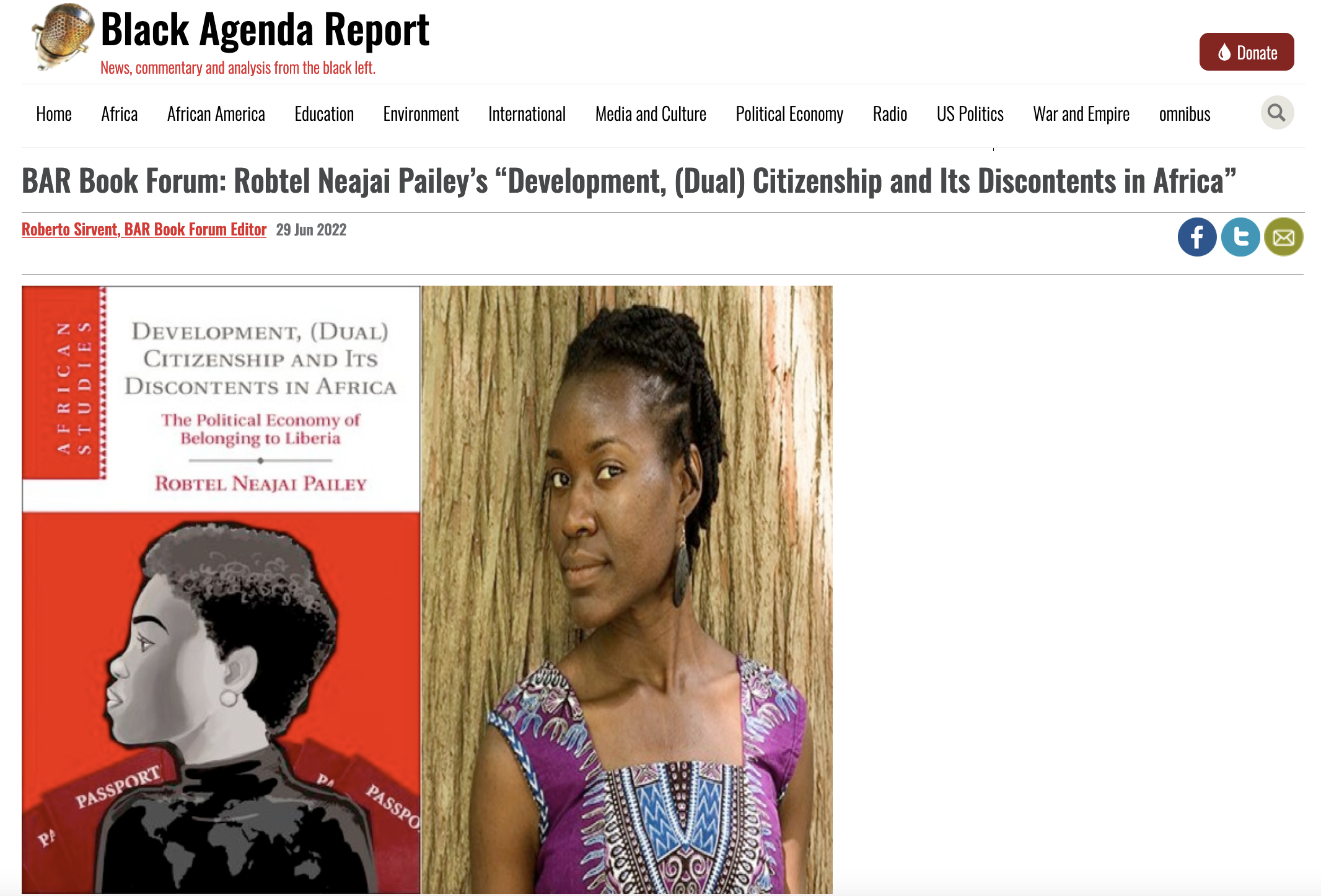
In this series, we ask acclaimed authors to answer five questions about their book. This week’s featured author is Robtel Neajai Pailey. Pailey is Assistant Professor in International Social and Public Policy at the London School of Economics and Political Science. Her book is Development, (Dual) Citizenship and Its Discontents in Africa: The Political Economy of Belonging to Liberia.

Roberto Sirvent: How can your book help BAR readers understand the current political and social climate?

Robtel Neajai Pailey: Development, (Dual) Citizenship and Its Discontents in Africa is the first to evaluate domestic and diasporic constructions and practices of Liberian citizenship across space and time and their myriad implications for development. By ‘development’, I am not referring to free-market capitalism, the single-minded pursuit of economic growth or the privileging of Western whiteness and modernity; rather, I understand ‘development’ to be a process whereby people’s experiences of poverty, power, privilege and progress in the so-called Global North and South are constantly mediated to effect change…
“Push-back Against Dual Citizenship Is Due to Inequality” (Daily Observer-Liberia)

...Says a Liberian Scholar

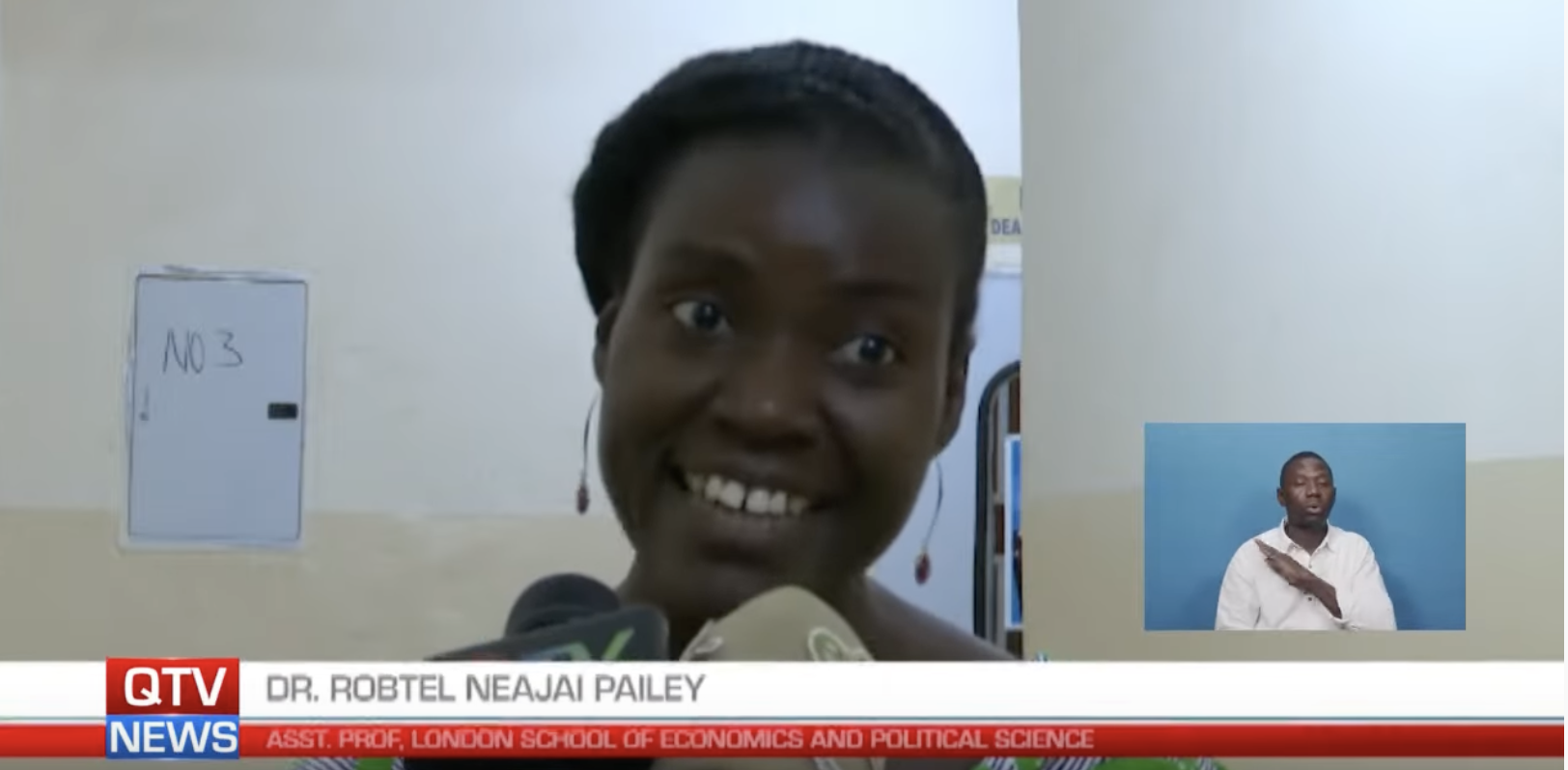
Acclaimed Liberian scholar Dr. Robtel Neajai Pailey has disclosed that public backlash against dual citizenship stems from socio-economic inequalities in Liberia. 

Dr. Pailey, an Assistant Professor in International Social and Public Policy at the London School of Economics and Political Science (LSE), was invited by the Liberian Senate on 14 December 2021 to present the findings and policy recommendations of her recently published book, Development, (Dual) Citizenship and Its Discontents in Africa: The Political Economy of Belonging to Liberia

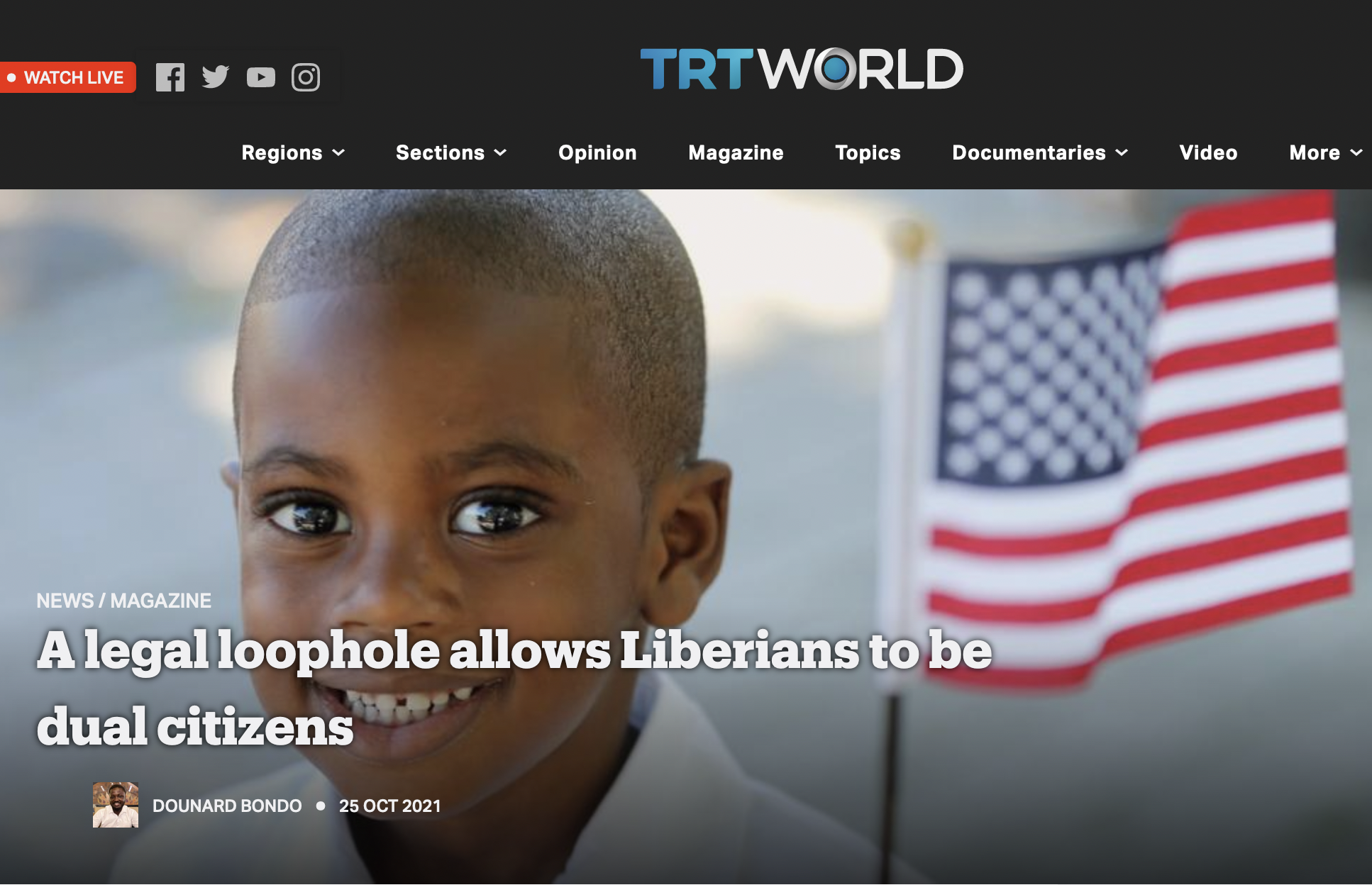
A Legal Loophole Allows Liberians to Be Dual Citizens (TRT World)

In 2005, Sarah moved from Liberia to America with her parents. By 2010, she naturalised as an American. However, at her naturalisation, the Liberian Aliens and Nationality Law automatically revoked her Liberian citizenship and made her illegible for a Liberian passport. This law is in line with a constitutional provision that bars dual citizenship for adults.

Sarah's case isn’t uncommon. After he was denied a Liberian passport by the Liberian embassy in Washington because he was American, Alvin Jalloh - a Liberian who naturalised as an American - sued the Liberian government.

In a 2019 judgement, the Liberian supreme court held that despite naturalising, Alvin could not be denied a Liberian citizenship and passport till he was tried in court. The court opined that citizenship was a right that could not be revoked without trial. 

Pursuant to this 2019 ruling, in September of this year, the Liberian ministry of foreign affairs was instructed to issue passports to Liberians who naturalised to other nationalities…

According to Dr Robtel Neajai Pailey, a Liberian scholar and author of Development, (Dual) Citizenship and Its Discontents in Africa, "The December 2019 Supreme Court ruling does not automatically authorize dual citizenship. It only states that a jus soli Liberian who naturalises abroad cannot be stripped of his/her Liberian citizenship without due process.”

She says further that while she believes dual citizenship is "inevitable for Liberia given national and continental trends, the country must address the many historical and contemporary inequalities that fuel backlash against dual citizenship as evidenced in a failed referendum proposition of December 2020…”

Gud Mornin Salone (Radio Democracy 98.1 FM)

Robtel Neajai Pailey discusses her new book with Gud Mornin Salone's Osman Kamara
Radio Democracy 98.1 FM

Visit https://bit.ly/30RsW3u for more information about Development, (Dual) Citizenship and Its Discontents in Africa: The Political Economy of Belonging to Liberia (Cambridge University Press, 2021). To order copies here with a 20% discount, enter the promo code PAILEY20 at checkout.

9781108836548pvs02.jpg

"Not a Panacea to Reconstruction": Liberia's Dual Citizenship Dilemma (LSE Research for the World)

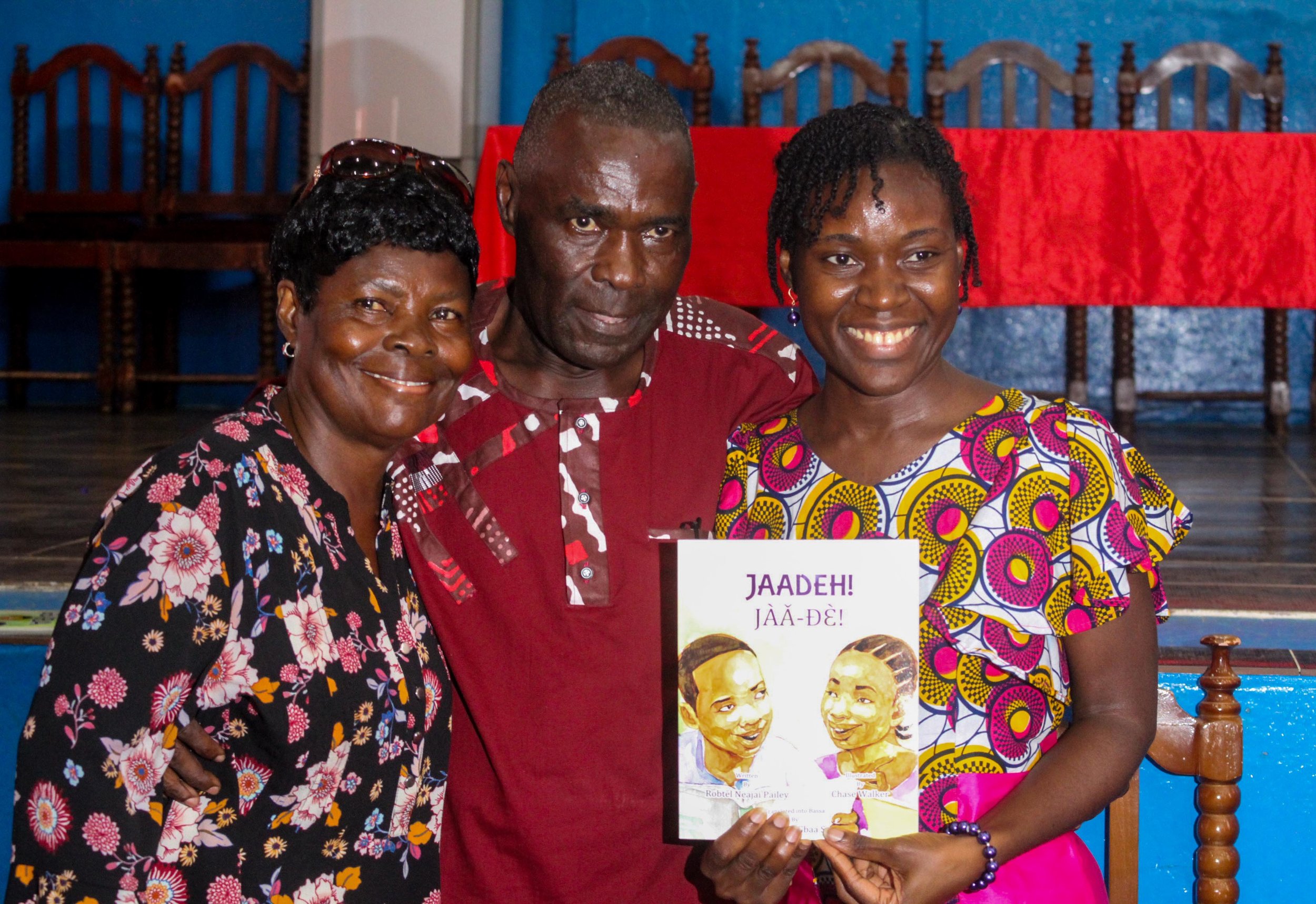
In her new book Development, (Dual) Citizenship and Its Discontents in Africa: The Political Economy of Belonging to Liberia, Dr Robtel Neajai Pailey tells the story of two Liberians by birth. One a warlord-turned-president and one an army pilot, they allegedly stole money from the Liberian government nearly 30 years apart, before absconding to the US, their adopted home.

Given these stories – which are examples of how those with connections abroad can evade the law - it’s not hard to see why dual citizenship is a contentious issue for Liberians. Just one of seven countries in Africa to currently prohibit dual citizenship, Liberia has wrestled for more than a decade over whether to extend citizenship rights to those who hold nationality elsewhere…
Screen Shot 2021-09-07 at 11.33.07 AM.png

Can You Be a Citizen of More than One Country? Here’s What to Learn from Liberia (The Washington Post)

Politicians and policymakers used to view dual citizenship as an anomaly that raised questions of divided loyalties to the nations involved. But both destination and origin countries are increasingly allowing their citizens to hold dual citizenship, and African countries are no exception to this trend.

Seven African countries — Cameroon, Congo, Equatorial Guinea, Eritrea, Ethiopia, Tanzania and Liberia — still prohibit dual citizenship. What explains why and how these countries remain holdouts? A new book by Robtel Neajai Pailey,Development, (Dual) Citizenship and Its Discontents in Africa,” explores in depth the Liberian case to show how Liberians at home and abroad have redefined and reconstructed Liberian citizenship and belonging — and, ultimately, the Liberian state…
Screen Shot 2021-08-27 at 9.23.59 PM.png

Liberia’s Political Economy of Belonging: An Interview with Robtel Neajai Pailey (ROAPE.net)

In this interview with Robtel Neajai Pailey, ROAPE asks her about her new book Development, (Dual) Citizenship and Its Discontents in Africa: The Political Economy of Belonging to Liberia. She argues that Liberia today must address historical and contemporary inequalities that have fuelled armed conflict and currently underpin claims against dual citizenship.

ROAPE: Can you please tell us a few things about your work and background?

Robtel Neajai Pailey: I have taken a rather circuitous route to academia. With over 15 years of combined personal and professional experiences in Africa, Europe and North America, I’ve worked across a broad range of fields while supporting governments, media institutions, multilateral, regional, non-governmental and community-based organisations. For example, in my mid-twenties, I served as special assistant for communications to Liberia’s (and Africa’s) first democratically elected female president followed ten years later by a stint in the executive office of the African Development Bank Group as an Ibrahim Leadership Fellow. I am currently Assistant Professor in International Social and Public Policy at the London School of Economics and Political Science, where I research race, citizenship, ‘South-South’ migration and development cooperation. Much of my life’s work sits at the intersection of scholarship, policy and practice, and is propelled by a deep commitment to social justice and radical storytelling…

Liberians’ Pleas for War and Economic Crimes Court Increase (The Washington Informer)

For years after the end of both the first and second Liberian civil wars, there’ve been ruminations about how, or if, the Liberian government would assemble a war and economic crimes court to hold accountable those who committed and continue to commit atrocities against the nation’s men, women and children.

Recently, grassroots activists and government officials have reignited calls for the judicial body. These demands come amidst both the rise of a former warlord to a top senatorial position and ongoing allegations of corruption and violence within the administration of Liberian President George Weah.

While the rallying cry has reached a fever pitch within a matter of weeks, some Liberians across the globe, including Robtel Neajai Pailey, have long used their platforms to espouse support of the court along with other measures that would allow Liberians to confront the deep-seated problems plaguing their small West African nation.

“It’s almost like the elephant in the room. People have to pay for those crimes,” said Pailey, the author of “Development, (Dual) Citizenship and Its Discontents in Africa” in which she challenges the popular notion that dual citizenship would improve Liberia’s socioeconomic situation. Additionally, she makes the case for Liberians to establish an identity outside of what the American Colonization Society manufactured in the early 19th century.

In her book, Pailey posits that since the country’s founding, Liberia has struggled to formulate citizenship norms under which each and every Liberian, regardless of ethnic identity or economic standing, feels included.

She said the relevance of this perspective comes at a time when those responsible for human rights abuses during the war continue to walk among the people and hold positions of power.

“People are still very supportive of the war crimes court [because] the level of impunity doesn’t bode well for the future. It sends a message that anyone can do anything,” Pailey said…


Focus on Africa (BBC World Service)

Robtel Neajai Pailey discusses her new book with Focus on Africa's Esau Williams
BBC World Service

Visit https://bit.ly/30RsW3u for more information about Development, (Dual) Citizenship and Its Discontents in Africa: The Political Economy of Belonging to Liberia (Cambridge University Press, 2021). To order copies here with a 20% discount, enter the promo code PAILEY20 at checkout.

Development Dual Citizenship and Its Discontents in Africa cover image.jpg

#IWD21: Four Women Inspiring Change in Liberia (Daily Observer)

International Women’s Day is set aside to celebrate women globally. Each year an annual International Women’s Day campaign theme is celebrated and continues all year long to unify direction and galvanize activity by providing a meaningful framework to connect and amplify the action, according to the International Women’s Day website. 

With this year’s theme, “Choose to challenge,” we look at four Liberian women who are challenging the status-quo and transforming the narrative on Liberian women. We would be remiss to acknowledge that Liberian women have been trailblazers in their own right, predating the Republic of Liberia itself. We are talking about giants such as (in no apparent order) the famous Madam Suakoko, Judge Emma Shannon Walser, Mae Antoinette Brown Sherman, Angie Brooks Randall, Dr. Thelma Awori, Ellen Johnson Sirleaf, Olubanke King Akerele and Cllr. Yvette Chesson-Wureh, to name a few — Liberian women with global significance. Below, we bring you the next generation of such outstanding women…

Screen Shot 2021-03-09 at 7.26.03 AM.png

Q&A with Dr Robtel Neajai Pailey (LSE Review of Books/Africa at LSE)

In this author interview, we speak to Dr Robtel Neajai Pailey about her new book, Development, (Dual) Citizenship and its Discontents in Africa: The Political Economy of Belonging to Liberia, which draws on life histories from over 200 interviews in West Africa, Europe and North America to examine socio-economic change in Liberia, Africa’s first black republic, through the prism of citizenship.

The virtual London launch of Development, (Dual) Citizenship and Its Discontents in Africa will be held at LSE on 25 February 2021 at 17:00 GMT. You can register to join the conversation. You can also download a free copy of the book’s Introduction.

Q&A with Dr Robtel Neajai Pailey, author of Development, (Dual) Citizenship and its Discontents in Africa: The Political Economy of Belonging to Liberia. Cambridge University Press. 2021.

Q: Can you explain what you mean by the ‘political economy of belonging’ and what this signifies for a post-war country like Liberia?

In the aftermath of violent armed conflict, identities, practices and relations between people transform, as was the case when Liberia’s protracted, fourteen-year armed conflict ended in 2003. I conceptualise this reconfiguration process as a ‘Liberian citizenship triad’ which involves a complex web of interactions amongst identities, practices and sets of relationships. I describe the triad further as a ‘political economy of belonging’: a transactional system in which socio-economic transformation depends on the provision of privileges/protections (‘rights’) in exchange for the fulfilment of duties/obligations (‘responsibilities’), and vice versa…

Screen Shot 2021-02-22 at 2.53.28 PM.png

Daybreak Africa (Voice of America)

FULL SHOW: Listen from 23:19 to 26:25 for interview segment BELOW.

Robtel Neajai Pailey explains her book Development, (Dual) Citizenship and Its Discontents in Africa
Voice of America

EXCLUSIVE interview segment BELOW.

Robtel Neajai Pailey explains her book Development, (Dual) Citizenship and Its Disconents in Africa
Voice of America

Visit https://bit.ly/30RsW3u for more information about Development, (Dual) Citizenship and Its Discontents in Africa: The Political Economy of Belonging to Liberia (Cambridge University Press, 2021). To order copies here with a 20% discount, enter the promo code PAILEY20 at checkout.

9781108836548pvs02.jpg

What Americans across the Political Spectrum Got Wrong about the Attempted Insurrection (The Washington Post)

As they struggled to make sense of the attempted insurrection at the Capitol on Jan. 6, observers embraced two strands of history to help contextualize them: the deep and enduring history of racism in the United States and the alarming parallels to the rise of Nazism in Germany. But to understand white supremacy among the pro-Trump mob, we need to look at America’s historical connections to global anti-Black racism…

While offering technical assistance, the Peace Corps also became an avenue for this racialized civilizing mission. More than 240,000 Americans have served in the Peace Corps, the majority of whom have been young and White. American gifts of laptops, Monsanto seeds or English classes to African nations presume that Africans aspire to be like Americans. This “white gaze of development,” Liberian political economist Robtel Neajai Pailey argues, has perpetuated the notion that non-White people cannot measure up to the living standards of White people.

Weekend (BBC World Service)

Robtel Neajai Pailey explains her book Development, (Dual) Citizenship and Its Discontents in Africa
BBC World Service

Visit https://bit.ly/30RsW3u for more information about Development, (Dual) Citizenship and Its Discontents in Africa: The Political Economy of Belonging to Liberia (Cambridge University Press, 2021). To order copies here with a 20% discount, enter the promo code PAILEY20 at checkout.

9781108836548pvs02.jpg